


Nestled at the north end of the Millennium Green is our spring fed pond and outflow stream that is a tributary of the iconic chalk stream River Test in the Upper Test catchment. A fabulous accessible path runs around two sides of the pond incorporating a viewing platform that’s a great place to connect with nature. In 2025 the footpath was extended into Batts Meadow as a grassy, permissive path to provide further access by the public to our precious chalk stream. It connects downstream to the Mill Trail (Whitchurch to Laverstoke) providing an alternative to walking on the busy B3400 to Laverstoke Mill. These paths have been created with the fantastic support of the National Lottery Heritage Fund and Watercress and Winterbournes Landscape Partnership Scheme, Basingstoke & Deane Borough Council, local supporters and with permission of local landowner to give the community the opportunity to enjoy the natural wildlife in this unique and rare chalk stream environment.

A path goes around the pond and connects to permissive path which join a public footpath in Batts Meadow. This gives an alternative, off road route to part of the Mill Trail.
Non-native invasive plant removal


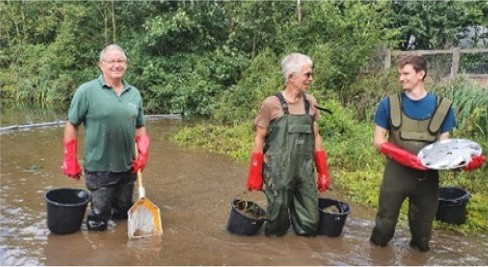
In 2020 a survey highlighted a number of invasive non-native plants in the pond and stream – Parrot’s Feather (Myriophyllum aquaticum), Yellow Monkeyflower (Mimulus Guttatus) and Water Fern (Azolla filiculoides). These were out competing the native plants and clogging the stream reducing the already slow flow. With the help of volunteers, a netting barrier was set up to prevent plant matter moving downstream and entering the Test. The plants were removed from the pond initially and then over a couple of years from the stream. The work is still ongoing to remove some persistent patches of Parrots’ Feather in the stream and is an important part onging management plan.
Image: Parrots Feather

Water Voles (Arvicola amphibius)

The stream is home to water voles. Previously common, these now endangered mammals are threatened by habitat loss and predation by American Mink. Laverstoke stream is an ideal habitat for them with a grassy bank one side providing the vegetation they love to eat and areas to burrow under overhanging vegetation on the other side. In winter they burrow, becoming more active again in March and April when they breed. They leave evidence of nibbled grass around burrows, cigar shaped droppings in ‘latrines’ and feeding piles of plant matter cut to length for carrying and then eating. If you don’t see water voles you might hear them as they have a characteristic ‘plop’ on entering the water. FIND OUT MORE https://www.wildlifetrusts.org/wildlife-explorer/mammals/water-vole
Other wildlife to be found in the pond & stream
The removal of unwanted invasive plants has improved the stream flow which will encourage further diversity of wildlife.
Aquatic invertertebrates
Monthly riverfly sampling takes place at 3 sites on the clear Upper Test main chalkstream. The Angler’s Riverfly Monitoring Initiative (ARMI) uses a standardised 3 minutes kick sweep sample and then counting of 8 types of invertebrates. A monthly score is uploaded to a nationwide database. The data is used to understand pressures on the chalks from poor water quality or flow rates and habitat changes. Currently results on our chalk stream show a fair abundance of the following canaries of the chalkstream.
• Mayfly – Olives (Baetidae), Blue winged olives (Ephemerellidae), Flat-bodied (Heptageniidae), True mayfly (Ephemeridae)
• Stonefly (Perlodidae)
• Cased caddisflies
• Caseless caddisflies
• Freshwater shrimp (Gammarus pulex)
Our vision is to have a pond and stream bursting with native wildlife and we shall be undertaking sampling here to see how successful we are.
More easily visible are the regularly seen waterfowl and dragonflies. A preliminary ecological appraisal identified that bats (Soprano Pipistrelle Pipistrellus pygmaeus and Daubentons Myotis daubentonii) will most likely use the area for foraging and commuting. We are also on the look out for reptiles such as grass snakes, and amphibians such as toads.
Plants to be found in the pond & stream
- Yellow flag iris (Iris pseudacorus)
- Water mint (Mentha aquatica)
- Sedges/rushes/reedmace (various)
- Water starwort (Callitriche palustris)
- Watercress (Rorippa nasturtium aquaticum)
- Marsh marigold (Caltha palustris)
- Sweet violet (Viola odorata)
- Harts‐tongue Fern (Asplenium scolopendrium)
- Goat willow (Salix caprea)
- Alder (Alnus glutinosa)
- Willow (Salix sp.)
- Elder (Sambucus nigra)
- Sycamore (Acer sp.)
- Butterburr or winter heliotrope (Petasites hybridus or Petasites fragrans) requires a survey
- Cleavers (Galium aparine)
- Bittersweet (Solanum dulcamara)
- Dog rose (Rosa canina)
- Reed/sedges/grasses (various)
Plants to be found in the boggy grassland beside the pond
- Great willowherb (Epilobium hirsutum)
- Water figwort (Scrophularia nodosa)
- Marsh Thistle (Cirsium palustre)
- Common comfrey (cream, purple) (Symphytum officinale)
- Cuckooflower (Cardamin pratensis)
- Water forget-me-not (Myosotis scorpioides)
Getting involved
If you would like to get hands on with regular maintenance and continued improvement of our community path, pond and stream area
Link to Get Involved / Donate – Laverstoke and Freefolk Millennium Green
